

The first few weeks of every new year spark lots of ideas, new projects, and brand-new yearly strategies. While using this momentum to innovate and create is great, it is also important to take the time to analyse the results from the prior year and extract the lessons learnt from 2025, in this case. Making data-based decisions can be really helpful for some businesses, particularly when marketing resources are limited, or stakeholders’ buy-in is needed to secure budget items or team bandwidth.
Who doesn’t like going through some statistics? That’s what we did at ACBio, focusing on our most active marketing channel in 2025, our founder’s LinkedIn page. We focused on the last four months of the year, where a concrete content marketing strategy and messaging had been rolled out.
In this blog post, we’re sharing our personal learnings from 2025 and the insights we have gathered over the last month through market and social listening on the big themes of 2026 for content marketing.
Learning 1: HIgh-quality content wins
Two of the top 5 performing posts of 2025 were content-rich posts containing a carousel attached. One covering Marketing vs Comms, the other 7 Common Mistakes when Building a Content Strategy. These two, together with an information-filled infographic with a Quick Advent website health check, were the 3 tops posts in number of saves. A metric that, together with new followers, shows genuine interest in the content shared beyond reactions and comments.
Overall, posts including carousels received a higher number of impressions (over 3,000 on average), while infographics resulted in higher engagement rates on average (7.8%), which included reactions, comments, saves, reposts, and clicks. Interestingly, infographics beat posts containing images in terms of engagement rates, and carousels beat them in terms of impressions. So even in the age where images act like magnets for social media engagement, high-quality content seemed to win.
LEarning 2: AI is not the enemy
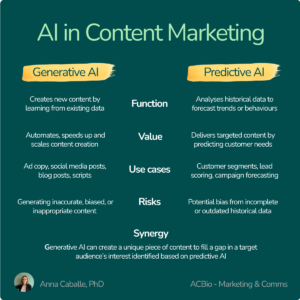
Another big learning for our team in H2 2025 was that AI, in particular generative AI*, is not a tool to be feared in content marketing but to be leveraged to improve output based on existing capabilities.
As specialists in content marketing, we value extremely our expertise, skills, and know-how when it comes to content strategy design, content planning, content ideation, content creation, and editing. Thus, we were hesitant to routinely use AI technology for content creation. We decided to begin testing its application on social media posts for our founder’s LinkedIn page during the last four months of 2025. However, we couldn’t leave it all to AI, and any AI-generated content was edited to match our founder’s voice and tone. While this probably unified non-AI vs AI-generated content, it was fun to compare the statistics between both groups. For full details on these, make sure to read our upcoming newsletter:
Overall, AI helped our founder to save time when creating content-rich assets, which contributed to a significant growth in post impressions, engagements, and new followers!
LEArning 3: with strategy and consistency, virality becomes anecdotal
While viral posts can help increase brand awareness and drive traffic to your profile or business website, those sporadic high numbers rarely turn into immediate business growth. For example, a random repost with an impactful picture went viral for us in 2025, while a repost from a client’s post on a new application note we created for them was seen by far fewer people… yet the second one had many clicks and provided proof of our services that prospective clients liked. It’s not all about the metrics but the outcomes… and about quality over quantity.
We believe in the formula of: Strategy + Consistency = Growth. This means having a clear strategy in place, executing the idea consistently (frequency, visuals, tone), and refining based on outcomes or to adapt to changing environments (while remaining aligned to the overall goals).
Having said that, on social media channels, it can be good to produce content with a degree of spontaneity. These posts can result in unexpected engagement and have deeper emotional connections with the audience.
Do you need help building your content strategy?
Check our Marketing & Comms Strategy service
What’s happening in 2026?
The widespread use of AI technology and AI agents in 2025 to produce content more quickly has raised questions about trust and authority.
Readers are filtering out buzzword-filled content in favour of authentic, relatable, and high-quality content. 2026 is about “re-humanising” content, adding the human touch back to create deeper connections based on trust. So authenticity and depth are being prioritised above volume and scale.
1. Stories need to have a clear human touch
- High-trust thought leadership: even if high-quality content is being produced, the credibility of a human expert is the ultimate competitive advantage. We’re seeing a transition from the “company voice” to the “expert voice”.
- Real-world context: whether it’s drawing from personal experience or a fictional situation emulating what happens in real life, giving real context that AI can’t copy is an advantage. This includes behind the scenes, personal anecdotes (ideally with a picture!), and sharing failures.
- Life science influencers: influencer marketing is on the rise in life sciences and can result in great partnerships. This fits into the new profile of “influencers” where credibility and professionalism are being prioritised over audience numbers in specialist fields like life sciences.
2. Changes in where, when, and how content is consumed
Omni-channel strategies have dominated content marketing in recent years. Particularly with the rise of AI agents in 2025, content can quickly and easily get pushed across all possible digital channels. While this might produce results, the trend in 2026 is to use those AI agents to tailor content distribution to different market segments or customer profiles. Together with the knowledge in a company’s CRM, these can predict the best time and channel for an ideal customer profile to see/interact with a specific piece of content.
Platforms are starting to penalise the inclusion of external links that take users away from sites, particularly in social media. There is now a tendency for zero-click content, whereby all the value is inside a post or in the one visual asset being used to draw attention to the longer form content asset. Along these lines, the use of short videos will continue to grow while static PDFs are getting more and more replaced by different forms of interactive content. Check our case study to learn more about this type of content.
Similarly, 2026 will see the rise of content planned in mini-series or episodes rather than long one-off posts with a lot of content. These new formats create “binge-worthy” brand experiences that make it more likely for users to return to a profile, potentially overriding feed algorithms.
3. The evolution of AI in Content Marketing
The 3 big shifts in content marketing & AI for 2026 are:
- Focusing on GEO: Structuring content so that AI models can “read” and cite your brand as an authoritative source. Generative Engine Optimization (GEO) and AI-Engineered Optimization (AEO) are moving ahead of SEO (Search Engine Optimization).
- Prioritising authenticity: whether that’s through founders who are becoming the face of their brand, using live experiences that AI can’t replicate, or creating non-digital experiences where possible.
- Effectiveness over efficiency: using AI to drive growth and outcomes instead of simply saving time, by integrating AI-generated content with strategic human thinking and craft.
*If you’re unsure how AI can be used for Content Marketing, here’s a little infographic we made. Access the high-resolution image here:
Do you need help building your content strategy?
Check our Marketing & Comms Strategy service or