

This past week at the Life Science Switzerland (LS2) Annual Meeting 2026 at the University of Zurich’s Irchel Campus was a masterclass in why the Swiss life science ecosystem remains a global powerhouse. Switzerland is a “biotech paradise” fuelled by discoveries in academic labs, and a bridge between academia and industry that requires a strategic map. At LS2, it was evident that even PhD students are thinking along those lines, with many of them making remarks on the direct implications of their research for the development of new drugs, or their willingness to pursue a career in industry (in Switzerland).
Since I started working in science marketing and comms, my perspective on scientific events has evolved. I’m no longer just looking at the data on a poster; I’m looking at the strategy, the stories, and the latest technical leaps coming from the bench with potential for the biotech and biopharma industries. Having said that, there were plenty of great posters and talks covering fundamental discoveries in biochemistry, cell & development biology, neuroscience, and in tool development. Which I thoroughly enjoyed!
During the event, I also reflected on how these gatherings (and being more senior in my career, too) are becoming less about passive listening and more about the active interactions and bringing to the table divergent points of view for the common good. Here are my three main takeaways from the event.
Seeing the unseen: new frontiers in microscopy
LS2 is organised in sections and multidisciplinary intersections, themes that bring together research efforts happening in institutes across Switzerland. Coming from a background in molecular biology and advanced imaging, the microscopy sessions were a personal highlight. The 2026 annual meeting theme, “fueling life across scales,” was perfectly captured by the leap in imaging technologies, and practically all keynote speakers showcased impressive microscopy images.
A true highlight of Day 1 for me was Prof Pierre Gönczy’s (EPFL, Lausanne) presentation for his Lelio Orci Award. His work on centrosomes and the fundamental machinery of cell division is legendary, and he reminded everyone that some discoveries take time, like producing a compound used to create CenSpark, which tracks centrioles and cilia in live specimens … showing that when the understanding of biology comes through, it’s truly magical!
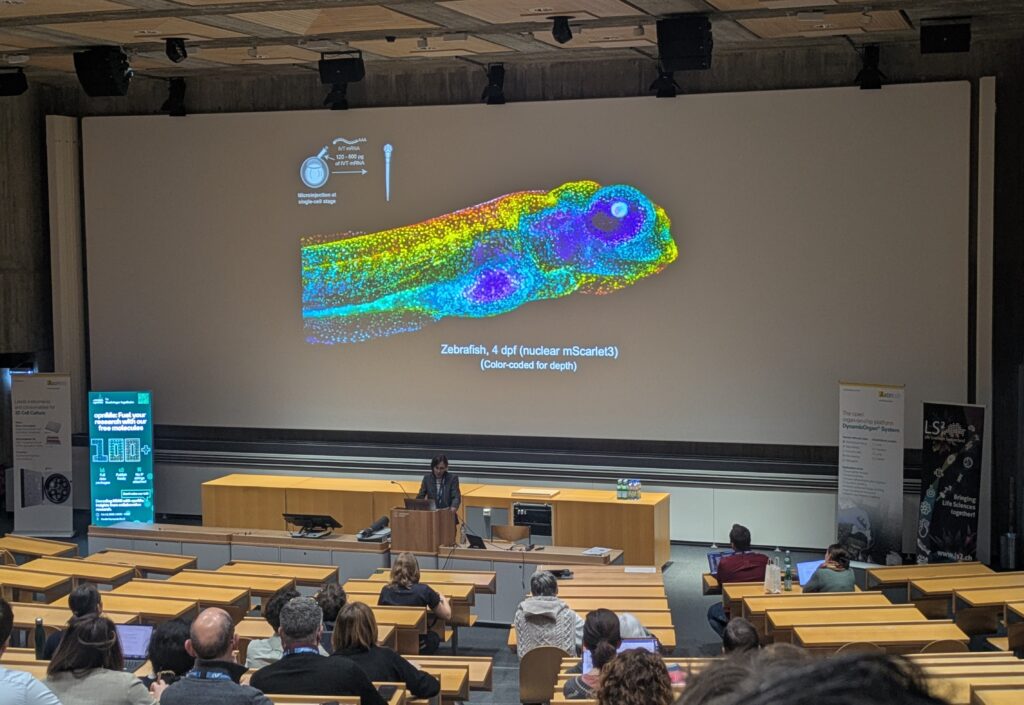
On Day 2, Prof Jennifer Lippincott-Schwartz’s keynote (Janelia, US) was the “north star” for the microscopy theme. She demonstrated how high-speed, 3D volumetric imaging and FIB-SEM are revolutionizing our understanding of organelle interactions. She introduced some original names to the audience, like mRNABow, which helps with multiplexed mRNA transfection to label and study 4 different organelles in Zebrafish, or Lunapark, which marks the sites that regulate membrane and secretory protein synthesis on the ER.
These talks also highlighted that imaging isn’t just about taking “pretty pictures”; it’s about understanding the dynamic processes that keep a cell alive and working properly. Other remarkable talks and posters within the “Advances in volumetric microscopy” section were the mesoSPIM initiative at the University of Zurich for imaging cleared tissues, Jan Huisken’s modular Flamingo microscopy, and volumetric imaging in general as a tool moving from niche development to facility-grade standards.
Finally, the Friedrich Miescher Award winner Omaya Dudin showed how his team and collaborators are literally mapping the history of life through the application of Expansion Microscopy on the oldest/closest living relative to animals. Together with brilliant work using multiplexed imaging for spatial biology studies or even super-resolution microscopy to unlock molecular mechanisms, this reaffirms that Switzerland isn’t just participating in the life sciences but defining them.
From academia to industry and the cool science
Something that was nice to see was how more junior researchers are given opportunities to showcase their research alongside award-winning leaders. I particularly enjoyed the sessions called “The PIs of tomorrow”, where aspiring group leaders could present their research and, more importantly, their plans to establish their own research groups. The jury and public awards went to Dr Olimpia Bompadre and Dr Juan Cruz Landoni, both from EPFL, who showed interesting research on early chromatin deregulation as a driver of colorectal cancer tumour evolution, and mitochondrial pearling driving mtDNA nucleoid disaggregation and distribution, respectively, both using convincing storytelling and top-notch communication skills. A session truly inspiring for anyone in the audience!
Among the cool science I witness, I can highlight AlphaFold being routinely used to unlock new molecular interactions and be able to speed up hypothesis testing, extracellular vesicles (EVs) being used for targeted drug delivery, or the use of simulations to assess the ability of micro- and nanoplastics to cross the blood-brain barrier and microtubule mutations in breast cancer.
Networking and the power of presence
There is something irreplaceable about face-to-face scientific exchange. Whether discussing a PhD student starting to work with squid embryos, a new startup’s go-to-market strategy, the enterprise AI competitive market, or catching up with established industry partners, the value lies in the “unplanned” conversations. In an era of digital-first communication, LS2 remains a vital hub where the Swiss community, small enough to be agile, large enough to be world-leading, comes together to turn a coffee break into a collaboration.
Understanding the Swiss ecosystem means recognizing that industry isn’t just “the other side”, it’s a partner. We need to stop viewing the PhD as just a degree and start seeing it as a toolkit of transferable skills (project management, critical thinking, and niche technical expertise) that the Swiss biotech sector is hungry for. The presence of so many industry partners at LS2 reinforces that the boundary between “lab bench” and “market breakthrough” is thinner than ever.
LS2 2026 was a reminder that while Switzerland is known for its mountains and chocolate, its true strength is its neutrality as a meeting ground for radical ideas. I left Zurich re-energized to keep telling the story of science and helping these breakthroughs find their voice in the global market.
And to all those young researchers, I’d say that whether you’re optimising a microscopy protocol, getting your own lab going, or eyeing a transition to a Swiss biotech cluster, the takeaway is the same: stay curious, stay connected, and keep fuelling the scale of your ambitions.
You can access the full LS2 2026 gallery (from Rutata Photography): here
Do you need help building your content strategy?
Check our Marketing & Comms Strategy service or