

High-intent technical buyers (even during the all-important research phase), partners, and procurement heads do not visit your site to read static product specs lists. They visit to answer one question: can this product solve my exact operational bottleneck faster and more reliably than my current setup?
In biotech, your “product” is not always a physical instrument sitting on a benchtop. It might be a proprietary platform technology, an assay system, or a specialised CRO/CDMO service capability. Regardless of the form your product takes, your webpage must function as an active conversion engine.
At ACBio, we help translate complex technology into high-converting digital assets. Today we highlight some work we did for our client ONI for the launch of Aplo Flow, their integrated fluidics system that automates the most complex multiplexed imaging workflows, helping researchers unlock reproducible 15 nm-resolution experiments at scale.
As part of Aplo Flow’s integrated fluidics launch to market, we helped prepare the product webpage (oni.bio/aploflow), including the overall webpage structure and copywriting. Instead of hiding specifications behind a PDF, the page translates automation for single-molecule-based discovery into a clear, outcome-led story.
Based on this example and several other pages that our team has created in recent months, covering instrumentation, technology, applications, and reagents, here is our 7-step framework on how to write biotech product pages that convert. It includes key adjustments to make when your product is a platform or a service.
The 7-step product (or platform) page architecture
Step 1: Lock the messaging strategy
Sit down with Product Management or Service Operations leads to map every technical capability directly to a customer outcome. Product and service leads know internal capabilities; marketers know customer friction. Bridge that gap by converting features into clear operational benefits. Once the value proposition and USPs are clear, you can start with the development of the webpage’s structure and content.
- For physical products: Map hardware speed or laser specs to sample viability or throughput.
- For platforms & services: Map assay sensitivity thresholds, turnaround times, or scale-up capacity to reduced drug development risk or faster regulatory approval.
Step 2: Pass the 3-second hero test
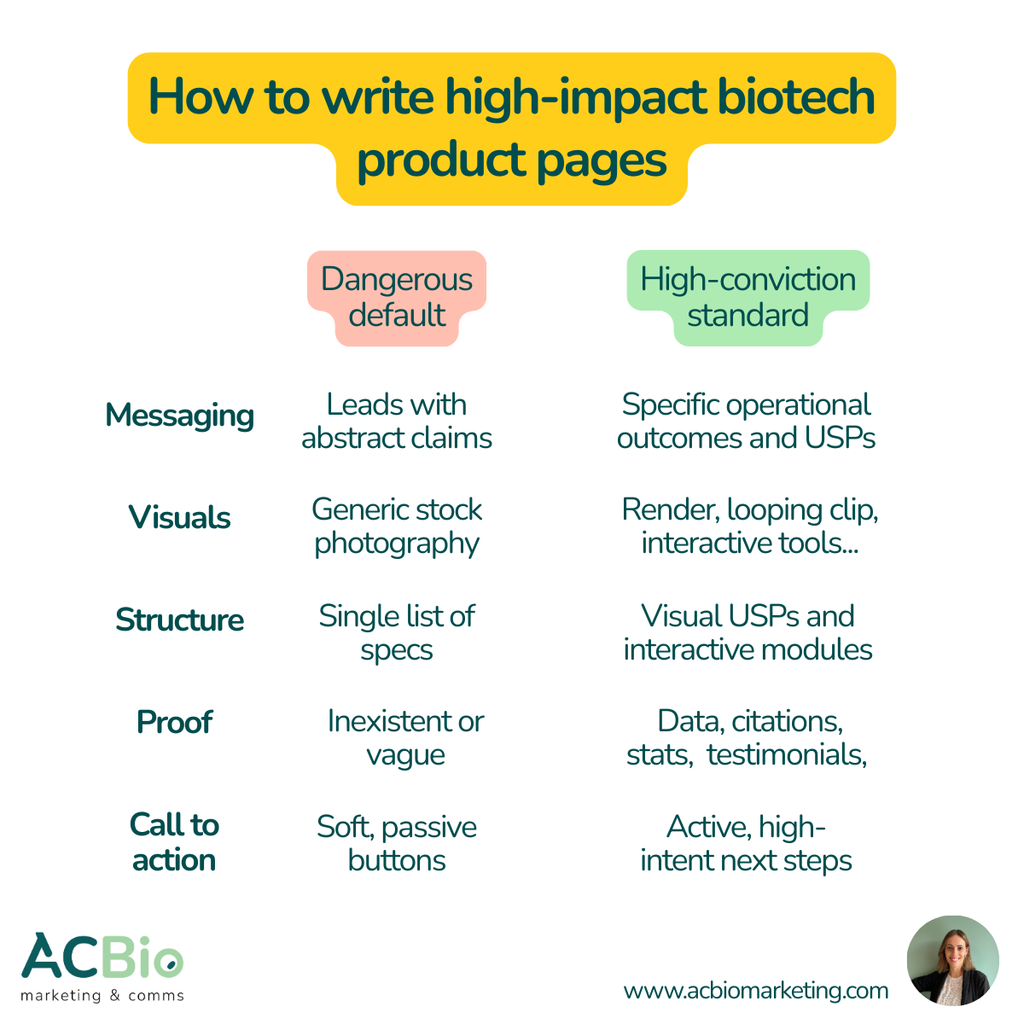
Your hero section must immediately state what the product is, the problem it solves, and (ideally) who it is for. Replace generic headlines (“The Next Generation of Flow Nanoscopy” or “End-to-End CDMO Services”) with high-conviction messaging (“Single-Molecule Sensitivity for Automated Flow Workflows” or “Accelerated Scale-Up for Complex Biologics”).
If a generic headline must be used, make sure the tagline is memorable and/or the first section immediately after the hero section, delivers on the “what”, “what for” and “for whom” principles. Pair it with a product render, software clip, or clean platform diagram; never stock photos.
Step 3: Highlight your USPs with brief, visual messaging
Once the reader has understood what the product or platform is about, it’s the time to present them with the key takeaways that differentiate your product from competing solutions or alternative technologies in the market.
Pair that with the use of icons, boxes, or other visual tools to keep them brief and quick to read.
Step 4: Add interactive visuals and virtual demos
Show, do not just tell. Technical decision-makers need to visualise how your product works in practice.
- For physical products: Use an interactive hotspot tool where visitors click on instrument features to reveal optics or fluidics details.
- For platforms & services: Use an interactive workflow explorer or mechanism map that lets users click through each phase of the technology pipeline or service process.
Step 5: Integrate data, peer validation, and/or social proof
Scientists and buyers trust peer validation over marketing copy. Place real-world proof directly alongside technical claims:
- For physical products & platforms: Display data supporting the USPs, peer-reviewed citations, or investigator quotes.
- For services: Display case studies, anonymised pilot study results, and testimonials highlighting turnaround reliability and data accuracy.
Aim to back up all claims with downloadable validation datasets, whitepapers, or side-by-side benchmark charts.
Step 6: Optimise for search engine (SEO), AI (GEO), and user metrics
Building a great product page is only half the battle; knowing how to write biotech product pages that convert means making it discoverable by search engines and AI answer engines like Perplexity or SearchGPT. Optimise your page for both humans and search algorithms by framing subheadings as direct buyer questions, placing technical specifications inside structured tables for easy AI data extraction, and embedding interactive assets that increase dwell time, asset download rates, and organic backlinks.
Step 7: Use command-led CTAs
Guide visitors toward concrete next steps. Replace passive buttons (“Contact us” or “Learn more”) with proactive commands.
- For physical products: “Book a 15-Minute Technical Diagnostic Call” or “Download the Full Validation Dataset”.
- For platforms & services: “Schedule a Technical Partnership Scoping Call” or “Download the Feasibility Study Dossier”.
*Bonus (optional) step: Use persona-based content tabs
CSOs care about data integrity and novel capabilities; lab managers and procurement heads care about throughput, SLAs, footprint, and unit economics. Use interactive tabs so visitors can filter content by their specific need or role. This may improve user experience while giving your marketing team first-party data on visitor intent.
After launching the page, a high-conviction product page becomes a continuous engine for first-party intelligence and performance optimisation. Rather than focusing on vanity traffic, track metrics that signal genuine commercial intent.
Monitor interaction rates on your visual modules: which persona tabs get clicked most often, how deeply visitors explore hotspot tools, and which technical specification accordions are expanded. Measure high-intent click-through rates, specifically dataset downloads, whitepaper requests, and bookings for technical calls. Finally, evaluate organic visibility in AI answer engines alongside downstream pipeline contribution: time on page, backlink acquisition from industry publications, and conversion rates from page visits to qualified sales opportunities.
Reviewing these signals regularly allows marketing teams to refine messaging, remove user friction, and continuously align digital assets with buyer intent.
Are you ready to upgrade your website? Do you need help nailing how to write biotech product pages?
A product page should never be a passive brochure, whether you are selling a physical instrument, a proprietary platform, or a complex service. By aligning internal teams, leading with clear messaging, and using interactive visual formats, you create a digital asset that builds trust and drives commercial growth.
📋 Audit your web assets: Assess your positioning using the ACBio’s messaging audit toolkit.
🛠️ Work with us: Book a meeting to discuss how to transform your technical platforms, products, and services into high-converting digital assets.