

In the fast-paced and highly specialised world of life science organisations, Marketing and Communications are traditionally treated as separate, distinct functions. They run on separate tracks, rely on isolated budgets, and report to different leaders.
But given the shifting dynamics of the industry and life science marketing overall, we must ask ourselves: are they really that different? Is this siloed approach truly the right strategy for modern biotech and pharma innovators?
Let’s dive into why connecting these isolated departments under a single, cohesive brand strategy is one of the most effective ways to strategically drive long-term growth (you can still keep separate teams, but get them synced!).
The dual engines of life science visibility
To understand how to merge these functions (famously known as MarComms), we must first break down what each team brings to the table. While they share the overarching goal of supporting scientific innovation and building trust, their daily execution targets entirely different pillars of the organisation.
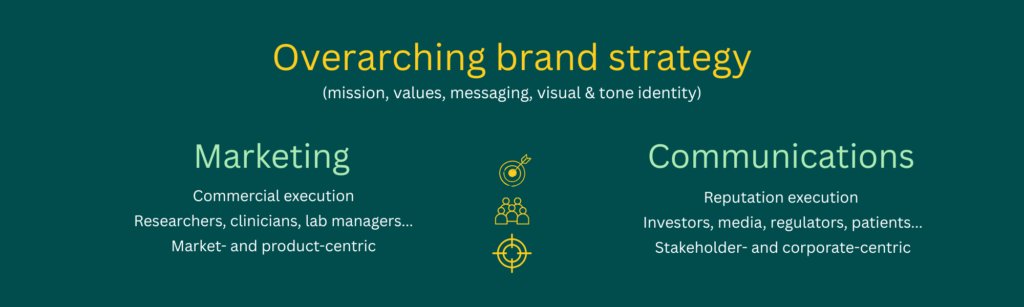
Marketing focuses on commercial value
At its core, marketing is market- and product-centric. Its primary goal is commercial revenue generation by directly engaging with operational buyers like researchers, clinicians, and lab managers. Through detailed product promotion and technical education, marketing shapes customer behaviour and drives product adoption.
Key activities under the marketing umbrella include:
- Strategic positioning: conducting robust market research, establishing go-to-market (GTM) strategies, setting pricing structures, and crafting core functional messaging.
- Behavioural change: communicating clear product value to catalyse behavioural changes within labs and clinics.
- Pipeline enablement: generating qualified commercial leads and building the specialised tools necessary to feed the sales funnel.
- Market authority: building targeted brand awareness and domain authority within specific technical market niches.
Communications focuses on corporate reputation
Conversely, corporate communications handles reputation management on a macro scale. It operates at an informational level and remains heavily stakeholder- and corporate-centric. Instead of focusing purely on the end-buyer, communications speak directly to a broader network, including investors, media professionals, regulatory authorities, and ultimately, patients.
Key activities under the communications umbrella include:
- Public Relations (& risk): managing PR, elevating the overarching brand image, and executing critical risk mitigation and crisis protocols.
- Milestone amplification: communicating complex R&D breakthroughs, clinical milestones, mergers & acquisitions (M&A), and financial updates to internal and external audiences.
- Regulatory compliance: establishing corporate transparency standards to maintain strict regulatory compliance across global boards.
- Trust cultivation: cultivating long-term brand trust and institutional credibility within the wider scientific community.
Four key reasons to synchronise LIFE SCIENCE marketing + communications
Maintaining a wall between these two disciplines poses a real threat to a company’s narrative consistency. When you purposefully synchronise your commercial marketing with your corporate communications, you realise four distinct advantages:
- Better alignment to achieve business goals: a synchronised approach ensures that short-term commercial campaigns and long-term reputation strategies push in the exact same direction, amplifying your ability to meet core business targets.
- Making complex science clear: life science products are highly sophisticated. Seamless integration enables organisations to translate dense, complex data into clear, impactful stories tailored precisely to various target audiences.
- Growing stakeholder brand trust: fragmentation breeds confusion. When investors, lab managers, and patients hear a unified, consistent message across every single touchpoint, their trust in your brand grows exponentially.
- Navigating stringent regulatory environments: operating within highly regulated fields means every claim is scrutinised. A joined-up MarComms framework makes it significantly easier to navigate strict compliance and regulatory mandates safely and effectively
The solution: an overarching brand strategy as the central blueprint
A close MarComms integration is absolutely crucial to ensure scientific accuracy and commercial impact across all corporate activities. But the operational question remains: how do you link them?
The answer lies in creating an overarching brand strategy. A true brand strategy answers the foundational questions: who is the company, and what does it stand for? It formally establishes the core mission, organisational values, visual systems, messaging pillars, and specific tone of voice identity.
Instead of treating brand strategy as a superficial design exercise, it must be embraced as the central blueprint that both Marketing and Communications execute. When marketing’s product positioning and communications’ reputation management stem from the exact same brand blueprint, your business achieves a rare, powerful synergy that accelerates market adoption and builds unbreakable industry credibility.
By guiding the audience from a written announcement straight to a live technical demonstration, we turned a single piece of validation data into a repeating, authoritative loop of biotech messaging conviction.
Need help aligning your marketing, communications, or brand strategy?
Aligning your commercial push with your corporate reputation is the key to unlocking sustainable growth. Get in touch with the team at ACBio today to explore how we can connect your life science marketing & comms functions into a powerhouse brand strategy.
Connect with ACBio: Get in touch using the form below to map out your multi-channel amplification strategy.